Syllabus
Course Overview
Whether in life or research, we’re often interested in relationships between 2 or more variables. For example, how is one’s commute time to class related to their distance from campus and mode of transportation? Or, how is voter participation related to a person’s age and political affiliation?
Statistical modeling is the art and science of turning data into information about such relationships of interest.
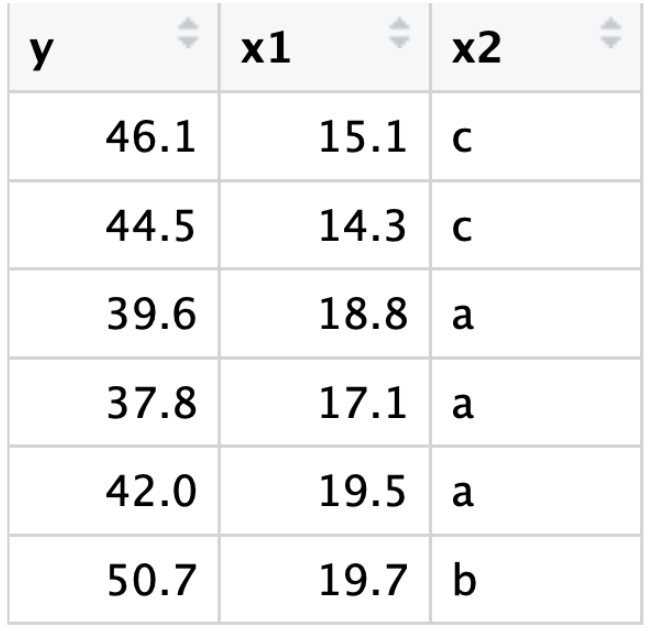
DATA
RELATIONSHIP
MODEL
E(Y|X_1,X_2) = \beta_0+\beta_1X_1+\beta_2X_{2b}+\beta_3X_{2c} + \beta_4X_{1}*X_{2b}+ \beta_5X_{1}*X_{2c}
INFORMATION
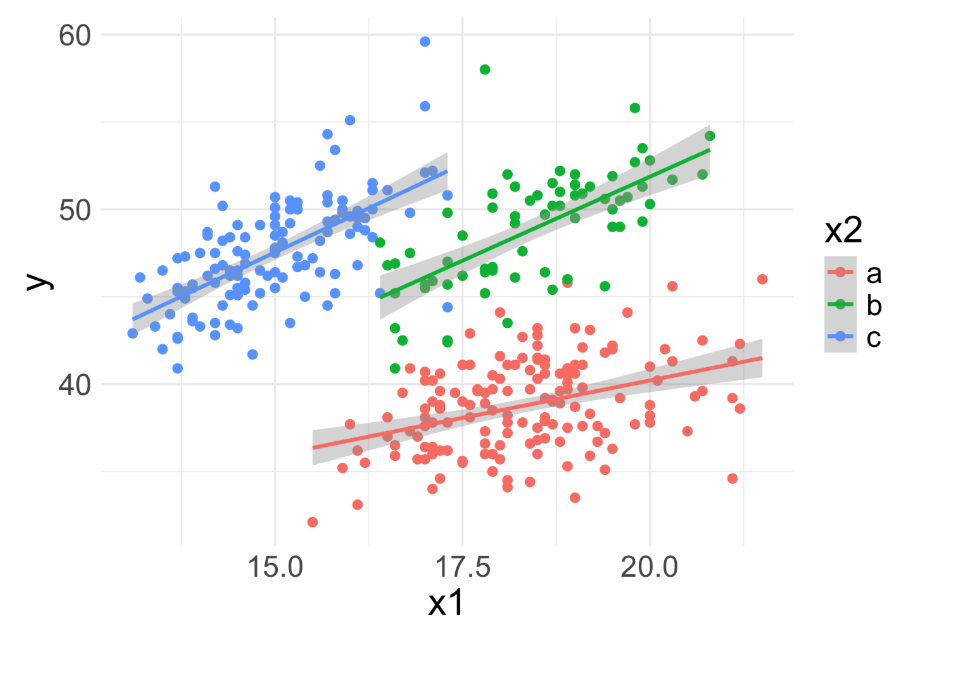
The average outcome Y is generally higher for groups b and c as compared to a and the relationship between the average outcome Y and variable X_1 is similar between groups a, b and c.
An introductory statistics course with an emphasis on multivariate modeling. Topics include descriptive statistics, data visualizations, multivariate linear regression, logistic regression, probability, model building and interpretation (i.e., confounding variables, causal diagrams, data context), and statistical inference (i.e., confidence intervals and hypothesis testing).
Learning goals
Important technical concepts
Upon completion of this course, students should be able to…
- Build, use, and interpret graphical and numerical summaries of data.
- Given a research question: identify an appropriate model, use sample data to fit the model in RStudio, evaluate the model’s quality, and quantify our uncertainty in the model’s coefficients and predictions.
- Use a sample model to make predictions & inferences about a population, using prediction / confidence intervals & hypothesis tests.
- Interpret & communicate an analysis in context & using appropriate notation, argumentation, & evidence.
- Describe potential advantages, limitations, and ethical considerations of a data set and statistical analysis.
- Identify common pitfalls in statistical analyses (e.g., spurious correlation vs. causal relationships, extrapolation, multicollinearity, multiple testing, practical vs. statistical significance).
Important statistical skills
The following skills are essential both within and beyond Statistics, and demonstrably improve your own learning and the learning of those around you:
- Move beyond a “homework only” study approach. Develop a deeper understanding of the material through continued review, reflection, and practice.
- Think creatively, and build confidence, applying course concepts in open-ended, novel settings.
- Be comfortable working through challenges and mistakes.
- Contribute to a welcoming, engaged, and positive learning environment.
- Work effectively in a group setting.
Topics & Tentative Schedule
| UNIT | GOAL | TOPIC | ~WEEKS |
|---|---|---|---|
| Simple linear regression | Model the relationship of a quantitative response / outcome variable Y with some predictor / explanatory variable X. | Univariate visual & numerical summaries Simple linear regression - Bivariate visualization - Model coefficients - Predictions & residuals Model evaluation - Model assumptions - R2 - Bias / ethics / fairness Transformations Categorical Predictors |
1-3 |
| Multiple linear regression | Model the relationship of a quantitative response / outcome variable Y with multiple predictor / explanatory variables (X1,X2,...,Xp). | Multiple linear regression - Multivariate visualization - Model coefficients - Predictions & residuals Confounding & interaction - Causal diagrams Model building - Overfitting |
4-7 |
| Logistic regression | Model the relationship of a binary categorical response / outcome variable Y with one or more predictor / explanatory variables (X1,X2,...,Xp). | Measuring uncertainty - log(odds) vs odds vs probability Logistic regression - Visualization - Model coefficients - Predictions Model evaluation - Accuracy, sensitivity, specificity - Confusion matrices |
8-9 |
| Inference | Use regression models built using our sample data to make inferences about the broader population from which that data was drawn. | Normal distribution Sampling distributions & the CLT Confidence intervals Hypothesis tests - t-tests & F-tests for model coefficients |
10-14 |
Course & Campus Resources
Instructional team

Brianna Heggeseth (instructor)
About me: Statistician and data scientist
MSCS Department @ Macalester College
My primary research interests lie broadly in the study of statistical models and machine learning algorithms and their application in practice. I have collaborate with colleagues in social psychology, environmental epidemiology, and genetic biology. See https://bcheggeseth.github.io/ for more information.
Students often wonder what to call their professors. I prefer to be called by my first name, Brianna (“Bree-AH-na”). If you prefer to be more formal, I’m fine with Professor Heggeseth (“HEG-eh-seth”) and I use the pronouns she/her/hers.
Please help me make sure that I call you by your preferred name (with correct pronunciation!) and pronouns too!
Email: Please email me (bheggese@macalester.edu) with any personal or academic concerns. I will do my best to respond within 24 hours on weekdays and 48 hours on weekends. For content questions, I encourage you to post in our Slack workspace (see below).
Office Drop-In Hours
Where: Olin Rice 125 (at the bottom of the interior southern staircase)
When:See my Office Hour Google Calendar for up-to-date office hour times.
Why: Office hours are a great time to talk about this class, career planning, or life in general. This is one of my favorite parts of my job, so please come chat! You should plan to attend my office hours at least once in the semester. If these office hour times don’t work with your schedule, I’m available by appointment; email to set up a time to meet!
Preceptors
We have several wonderful STAT 155 preceptors this semester! Their role is to help students with content questions, assist in the navigation of available resources, advise on studying approaches, and assist with concepts, tools, and skills. Students are accountable for their own learning; as such, preceptors are not allowed to share answers to assignments (unless specifically directed by the instructor), they are not expected to immediately know the right approach to an exercise, and they do not provide assistance outside of office hours. Relatedly, you should not email preceptors.
In hiring preceptors, I prioritize and emphasize kindness and respect. I expect the same of students in their interactions with the preceptors. Please utilize and respect their experience and commitment to supporting you in this course. Please check out some additional guidelines and expectations on how to interact with preceptors.
Course Resources
Online course manual: In-class activities (with solutions) and a daily schedule.
Moodle: General resources, course calendar, submission links, feedback.
Slack: We’ll use this platform to communicate outside class.
- If you’re new to Slack, this video provides a quick overview.
Office hours (OH): There are many instructor & preceptor OH each week. Names, times, & locations are on the Moodle course calendar. IMPORTANT: Before going to OH, always check the calendar & #general-announcements on Slack for any changes in the schedule.
On Campus Support
Academic Success @ Mac
Mac’s Science and Quantitative Center (SciQ) has drop-in tutoring for STAT 155 (and many other math, science, and econ courses); and Academic Coaching provides one-on-one support for study skills, time management, reading, note taking, and effective learning strategies. Seeking help is a sign of strength and maturity!
Center for Disability Resources
The Center can help advocate for & establish learning accommodations.
find help This go-to page includes links to various student, housing, food, academic, and financial resources. Included:
Emergency aid fund for students experiencing unexpected financial hardship.
Reporting incidents of harassment, bias, & discrimination.
The Title IX site includes guidance on reporting concerns pertaining to Mac’s Title IX & Sexual Misconduct Policy.
mental health & wellness The Hamre Center can provide or connect you to ongoing, urgent, emergency, and telehealth care.
Thriving & Asking Questions
Thriving in Stat 155
| Plan Ahead | You should plan to spend ~10-12 hours on any 4-credit course, including class time. Stay up-to-date on the course calendar and carve out time for studying & doing homework. |
| Do the things | At minimum, thriving in this course requires the completion of some concrete tasks. Complete all assignments, regularly attend & engage in class, complete in-class activities (which might mean completing work outside of class), and check the activity solutions. |
| Build a foundation | If your main focus is on checking off some boxes, you won’t get much out of this course (or college in general). Deeper, enduring learning requires more. Carve out time to rewrite, reflect upon, & review your notes. Summarize concepts in your own words. |
| Engage, Ask questions, Have fun | Actively participate in the class & take ownership of your learning. PLEASE: Don’t be afraid to ask for help, make mistakes, and ask questions! These skills are critical to your well-being & learning. Finally, have some fun, be curious, and reflect upon what surprises you about the material and yourself. |
Asking Questions
OFFICE HOURS (OH)
OH are a great place to chat about the course, career planning, life,… Please visit us!!
OH times & locations are on the Moodle course calendar. Be sure to check the calendar before heading out to OH as details may change! OH are oriented around group discussion. They are not first come, first served appointments. Since it’s not an effective way to deepen your learning, OH are not a place to sit and do assignments with me or preceptors. It’s an opportunity to discuss concepts & specific questions.
SLACK
This is where we’ll communicate outside class. You’re expected to keep track of the following:
#general-announcements: announcements relevant to all 155 sections (e.g. changes to preceptor OH)
#section-0x-heggeseth: announcements directed at just your section
#discussion-forum: Where students can post and answer questions.
This is an informal way to converse, ask questions, share info, & connect. Do not expect instructor responses outside 9am-5pm on weekdays.
When you have a question for your instructor…
- If it’s not private, you must post it on the Slack #discussion-forum (e.g. for questions about assignment exercises, concepts, RStudio) or #section-0x-heggeseth (e.g. for questions about the course policies, schedule, etc just for our section). Your questions will be answered there so that all students have access to the same information.
- If it’s personal (e.g. about an absence), email me. Do not expect a response outside 9am-5pm on weekdays.
- It’s good, professional practice to check whether your question is already answered in provided resources. Ex:
- info on what to do if you miss class → syllabus
- due dates → course calendar at the top of Moodle + course schedule in the online manual
- quiz dates → syllabus + course calendar at the top of Moodle + course schedule in the online manual
- homework policies & grading → homework policies & grading doc
- finals week → syllabus + course calendar at the top of Moodle + course schedule in the online manual
Core Components
- ENGAGEMENT
Engagement is important to your own learning & to fostering a supportive learning community. To share clear & consistent information, any deviations from these expectations will be recorded your individual spreadsheet.
- Do not miss >5 in-person class sessions. (6-9 absences will lower your grade. 10+ absences will result in a D/NC.)
- When attending class:
- be on time & don’t leave early
- do not use your phone (phones must be put away when you enter the course, even if class hasn’t started)
- do not use your laptop for anything other than taking notes (e.g. no videos, no email, no messaging apps, etc)
- leave the classroom to attend to your bodily needs but return to class as quickly as possible
- be actively present (e.g. don’t work alone, don’t work on other courses, etc).
- collaborate effectively
- use your group members’ correct names (& pronunciation) and pronouns
- actively contribute to discussions & invite all other group members into discussion
- create a space where others feel comfortable making mistakes & sharing their ideas
- Outside class:
- check your email for announcements and stay updated on the Slack forum
- when you have questions, or just want to chat, please stop by OH!
- PREPARATION (Checkpoints)
Roughly half of our class sessions will require some preparation. Before class you will watch videos which introduce new concepts and definitions, then take a low-stakes checkpoint quiz (CP). This will help us prepare for class, build a common foundation, & maximize our time together – just how readings & reading reflections might be used in another class!
Pass 13+ of the 16 CPs (pass ~80%); OR earn at least 80% of total points across all CPs.
POLICIES:
- CPs are due 10 minutes before class on the assigned date. There are no extensions for CPs. They’re important preparation for the relevant class session.
- You will make mistakes and that’s ok!
- You can reattempt most CP questions with a 33% penalty for each incorrect response. Exceptions are open-ended questions or multiple choice questions with only 2 options (TRUE/FALSE).
- CPs are graded pass / fail. To pass, you must earn at least 80% of the points.
- The goal is to pass 13+ CPs. Thus you might miss or not pass 3 CPs without it impacting your grade.
- PRACTICE (Problem Sets)
In 8 practice sets (PS), you will practice and explore the course material in more depth. The following flexibility is built in to help reduce stress and to facilitate deeper learning. Detailed directions and policies are here.
- Grading You can make some mistakes without it chipping away at your score (e.g. you will earn 5/5 points on an exercise if it’s at least 90% correct & complete).
- Extensions Limited extensions will be provided.
- INDEPENDENCE & APPLICATIONS (course project)
More details will be provided later in the semester. Here are some basics:
- We’ll start working on projects in ~week 6, with the majority of the work happening later in the semester.
- The projects are collaborative. You will be working in groups. Though you will work in assigned groups at various points throughout the semester, you will pick your own group for the project. This is something to think about as you meet other students in class.
- Project grades will be based upon a final group written report (no oral presentation), multiple group and individual checkpoints, and individual contributions to the project (it’s possible for different group members to earn different grades).
- CONTENT EXPERTISE (quizzes)
Your course engagement, preparation, practice, and application will support your deeper understanding of the course material. This will be assessed through three quizzes. These are in-person quizzes. You must schedule all travel etc around them.
- Quiz 1: Monday, February 16. 1 hour in class.
- Quiz 2: Monday, March 30. 1 hour in class.
- Quiz 3: During Finals Week
- 1:10-2:10pm section: Friday, 5/8 from 1:30-3:30pm
- 2:20-3:20pm section: Thursday, 5/7 from 1:30-3:30pm
- The exam will be written to take ~1.25 hours, but you will have the full 2-hour period to complete it.
Quiz policies:
All quizzes will have the following format:
- taken individually, using pen/pencil & paper
- you will not need to write code, but you will need to read & interpret R output
- no calculators (you will not need one)
- closed notes (no note cards, laptops, etc)
Quizzes 2 & 3 will be cumulative. This is unavoidable as the material builds upon itself.
Revisions: On Quizzes 1 & 2, there will be limited opportunities for revision. To earn up to 33% of missed points back:
Write corrections for any exercise on which you missed points.
These must be on a separate sheet of paper (not your original quiz), clearly labeled, and with exercises listed in numerical order.
You can chat with other students currently taking STAT 155, but nobody outside that group.
You can discuss concepts with the preceptors or instructor, but we will not check your revisions.
On a separate piece of paper, write a reflection about: (a) the alignment of your expectations of how your did and the reality of the feedback of the quiz, (b) what you learned from doing revisions, and (c) what, if anything, you’d like to do differently going forward in the course.
Staple your corrections and reflection to the back of the original quiz. Put the staple at the top left corner.
Submit this material to the instructor, no later than 1 week after quizzes were handed back in class. Late submissions will not be accepted for a grade.
You cannot earn back points on Quiz 3 for revisions as it occurs during finals week.
- REFLECTION
Roughly every month in the semester, you will write a reflection in which you consider your progress towards the learning goals, in and out of the classroom, and next steps. You’ll complete this in a provided Google Doc named “STAT 155 Reflection - YOUR NAME” that is shared only between the student and the instructor. Reminders (with a link to the document) will be sent via email prior to the deadlines (Feb 20, Apr 3, May 4).
- Written reflections about your learning are thoughtful and complete.
- Do not resemble text written by Generative AI or are copied from another source.
- Completed by the provided deadlines.
Course Policies
Flexibility
I provide transparent accommodations to all students. It helps reduce stress and the “hidden curriculum” (not everybody feels comfortable asking for flexibility).
- It’s ok to miss the occasional class.
- Practice sets: limited extensions and limited mistakes without penalty.
- Checkpoints: your lowest scores are essentially dropped and there are limited mistakes without penalty.
- Quizzes: limited revisions.
Additional flexibility will be provided in rare extenuating circumstances, upon discussion. Exceptions must be discussed with me (not assumed) early on (not after the fact). PLEASE REACH OUT WHEN YOU NEED HELP.
Absences
It’s ok to miss the occasional class. Except in rare extenuating circumstances (which must be discussed in advance):
- 5 or fewer absences will not impact your grade
- 6-9 absences will impact your grade (see grading section)
- you cannot pass the course if you accrue 10+ absences (more than 25% of class sessions)
- Send me a quick email. You do not need to share a reason for your absence, especially if it’s personal. It’s just a simple courtesy & keeps communication lines open.
- Check the Course Schedule in the online manual for what is happening in class that day.
- Complete the in-class activity on your own & check the solutions posted in the online manual.
- Ask any follow-up questions on Slack or in OH.
Artificial Intelligence
Using generative AI tools is an emerging skill. You may use AI (ChatGPT, Gemini, Grok, etc), with some caveats & limitations:
AI is not a good resource on topics for which you don’t yet have expertise. Relatedly, though AI can be helpful with parts of a statistical analysis (e.g.: getting unstuck on code, checking grammar), you have to guide that process (e.g.: what questions are we trying to answer? what’s a reasonable approach?).
Work on an exercise for at least 30 minutes before even thinking about AI. You will learn very little if you overly rely on generative AI, hence be unprepared for other interactions with the material (e.g.: in-class discussions, quizzes, future courses that build upon 155, etc). Learning comes from you doing the puzzling, not from you producing a correct answer. Whether or not you use AI, you must be able to defend / explain any code / discussion you hand in.
You cannot simply use generative AI to bypass your own learning. You may not use AI to generate entire arguments or discussions. Putting code and discussions into your own words is critical for your own deeper learning, independent thinking, and creativity. (For example, imagine how little you’d learn in a language course if you simply used AI to translate all text for you!!) Any use of generative AI must be cited, just like any other resource.
Academic integrity
MSCS strives to provide a learning environment that is equitable, inclusive, welcoming, mutually respectful, and free of discrimination. You’re expected to follow the MSCS Community Guidelines. You’re also required to be familiar with & follow the college’s academic integrity & other academic policies. In addition to the examples listed there, academic violations in this course include but are not limited to the following:
Using any materials from any past STAT 155 course, at Mac or elsewhere. Also, you should not provide any materials to any future 155 students.
Gaining access to, using, or distributing solution sets.
Passing off others’ work as your own. You must be able to defend / explain all work you hand in.
Using AI without citation, to generate entire discussions / code blocks, or without being able to defend the results.
Policy violations will result in a score of 0 on the work & be reported to the Asst. Dean of Academic Programs & Advising.
Final Grades
The grading system in this course is designed to help you achieve the learning goals while allowing space to make and learn from mistakes along the way. Your final course grade will consist of three components (Content Expertise: Quizzes, Practice: Problem Sets, & Application: Project) weighting the Content Expertise higher than the lower stakes opportunities designed for practice and develop that expertise, modified by your progress toward the Engagement, Preparation (Checkpoint), & Reflection goals:
Course percentage
- 25% Practice Sets
- 25% Project
- 50% Quizzes
| Grade | Course percentage |
| A | > 93% |
| A- | 90-93% |
| B+ | 87-90% |
| B | 83-87% |
| B- | 80-83% |
| C+ | 77-80% |
| C | 73-77% |
| C- | 70-73% |
| D/NC | < 70% or in the case of 10+ absences |
Grade modifiers
- Engagement (including attendance & collaboration) +
- Preparation (checkpoints)
- Reflection (monthly reflections)
| Modifier | Scenario |
| none (e.g. A → A) |
meets expectations in all areas (Engagement, Preparation, & Reflection) |
⅓ lower grade (e.g. A → A-, B+ → B) |
meets or demonstrates strong progress toward expectations in all areas (e.g.: 6 absences or 70% Checkpoint total or completed all but 1 reflection) |
1 lower grade (e.g. A → B, A- → B-) |
meets or demonstrates moderate or strong progress toward expectations in all areas (e.g.: 7-8 absences or 50% Checkpoint total or completed all but 2 reflections) |
| >1 lower grade | demonstrates little progress toward expectations in at least one of the areas |
| Drop to D/NC | has 10+ absences |
NOTE: The above table presents general scenarios. Please reach out to the instructor if you want to discuss your progress toward meeting expectations in these areas.
Caveat: The goal of sharing this specific information is to provide transparency around final grades, hence clear goals to work toward. That said, assigning grades is much more nuanced than any grading rubric / framework might suggest (for good reasons). What’s shared here is a worst case scenario – it represents the lowest a grade might be if you meet the corresponding goals.